
How to Protect Your Business From ADA Website Lawsuits in 2026
The ADA lawsuit wave isn't slowing down. It's accelerating. In 2026, plaintiff law firms have refined their screening processes, courts have reinforced that the ADA applies to websites, and the average mid-sized business is more exposed than ever — most of them don't even know it.
If your website isn't accessible to people with disabilities, you're not just risking a lawsuit. You're inviting one.
Here's what every business owner in the US needs to understand about ADA lawsuit risk for business owners — and exactly what to do about it before a demand letter shows up in your inbox.

What Is an ADA Lawsuit?
The Americans with Disabilities Act (ADA) Title III prohibits discrimination by businesses considered "places of public accommodation." Federal courts — particularly in New York — have consistently interpreted that to include business websites, mobile apps, and online services.
So what is an ADA lawsuit, in practical terms? It's a federal complaint alleging that a person with a disability couldn't use your website because of accessibility barriers — missing alt text, broken keyboard navigation, poor color contrast, unlabeled form fields, or some combination of WCAG violations. The plaintiff doesn't need to prove damages. They only need to prove the barrier existed.
Most cases don't start in court. They start with a demand letter from a plaintiff's attorney, typically asking for $10,000 to $25,000 to settle before filing. Ignore it, and you're in federal court within weeks.
ADA Lawsuit Risk for Business Owners: Who Actually Gets Sued
The biggest misconception we see is that website accessibility lawsuits only target Fortune 500 enterprises. The data says otherwise.
There is no small business exemption under ADA Title III. UsableNet's 2025 research found that 36% of sued companies had annual revenue above $25 million — which means the majority, 64%, did not. If your website is publicly accessible and you conduct business online, you are in scope.
The industries taking the hardest hit in 2025:
E-commerce and retail — roughly 69% of all digital accessibility filings
Restaurants, food and beverage — over 30% of H1 2025 filings
Healthcare, financial services, hospitality, and SaaS — rising steadily
Geographically, New York led with 1,021 federal filings in 2025, followed by Florida with 961. Pennsylvania saw 137 cases. A small group of 16 law firms was responsible for over 90% of website accessibility lawsuits filed in the first half of 2025 — these are volume operations, not isolated incidents.
A new threat also emerged: pro se filings (plaintiffs representing themselves using AI tools) jumped 40% year over year. The cost of filing a complaint has dropped to near zero. Your exposure has not.
The Real Cost of ADA Website Accessibility Settlements
Here's where most business owners underestimate the damage. The sticker price of a settlement is only the beginning.
Typical financial outcomes for ADA website compliance lawsuits:
Demand letter settlement: $5,000 – $25,000
Out-of-court settlement: $25,000 – $75,000
Court judgment: average $85,000
Class action: $400,000 and up — Fashion Nova settled for $5.15 million in 2025
Then add defense legal fees ($30,000 – $175,000), mandated remediation costs, and the operational disruption of pulling developers off revenue work to fix violations under deadline. And factor in repeat risk: 46% of federal ADA website cases in 2025 involved defendants who had already been sued at least once.
The math is straightforward. Proactive compliance costs a fraction of reactive defense.
Why Accessibility Widgets Will Get You Sued
In 2025, the FTC fined overlay vendor AccessiBe $1 million for misrepresenting its widget as guaranteed ADA compliance. That same year, 22.6% of websites sued for accessibility violations already had an overlay installed.
Overlays don't fix broken code. They layer a shallow interface on top of an inaccessible site — one that screen reader users often find worse than the original. Courts know this. Plaintiff attorneys know this. Regulators now know this.
If your compliance strategy is a widget and a disclaimer, you are not protected. You are pre-selected.
How to Actually Protect Your Business in 2026
Real protection comes from a documented, code-level compliance program. Here is the framework our experts use with clients.
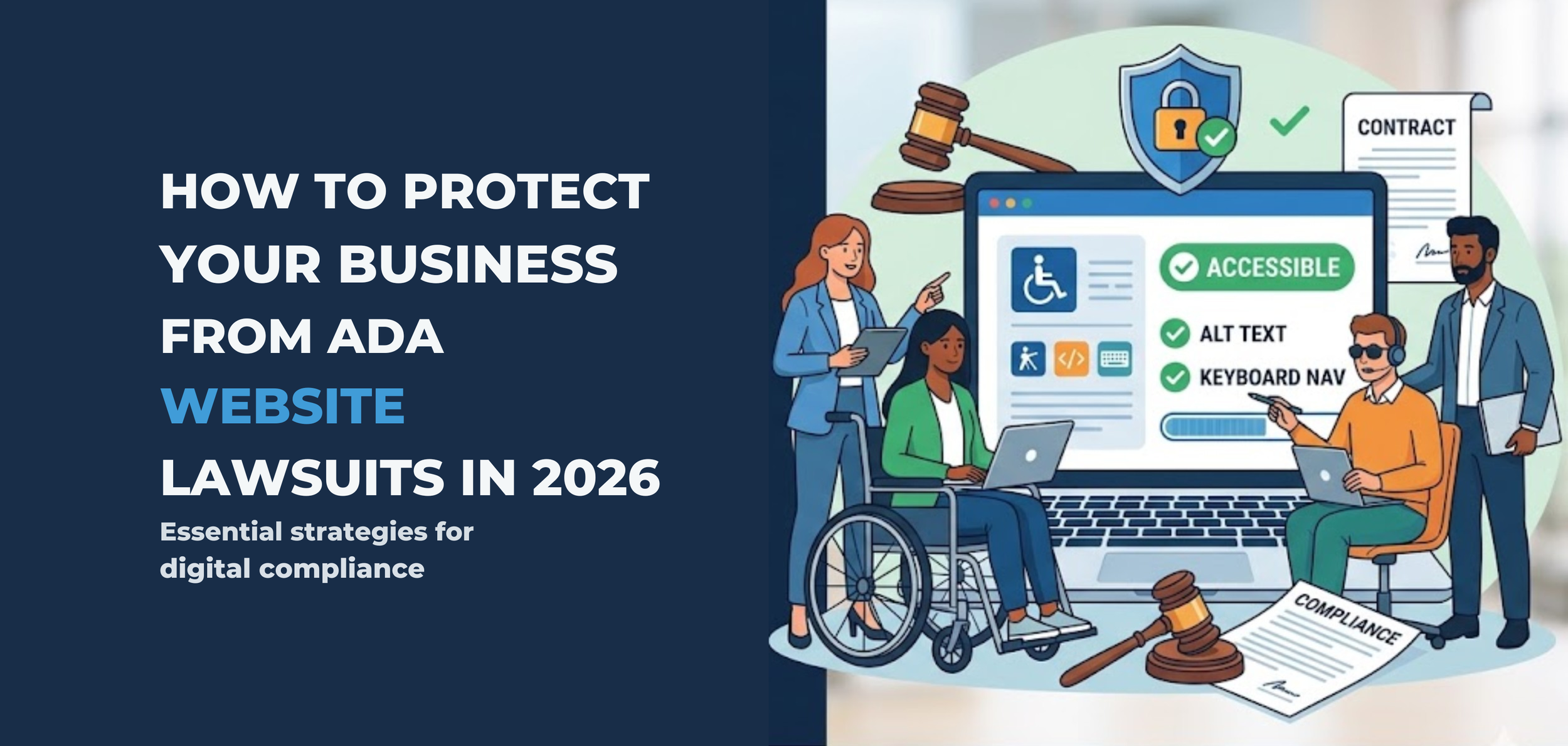
1. Get a legitimate WCAG 2.2 AA audit. Not an automated scanner report. A full manual plus expert review mapped to WCAG 2.2 Level AA criteria — the de facto legal standard. Start with anADA website audit conducted by certified accessibility specialists, not software alone. Automated tools catch only about 30% of real issues.
2. Remediate at the code level. Every finding needs a prioritized fix, developer-ready documentation, and a realistic timeline. Your remediation plan becomes part of your legal defense — evidence of good faith compliance effort that courts weigh heavily when assessing settlements.
3. Publish an accessibility statement. A public statement detailing your compliance posture, WCAG target level, and contact channel for accessibility concerns signals proactive good faith. It's standard practice under any legitimate web accessibility program.
4. Implement continuous monitoring. Websites change. A fix today can be undone by a theme update, a new plugin, or a marketing team image upload tomorrow. An ongoing WCAG monitoring service catches regressions before a plaintiff does.
5. Train your team. Developers, designers, and content creators introduce most new violations. A one-time audit doesn't stop that cycle. Internal training does.
6. Document everything. Audit reports, remediation tickets, training records, monitoring logs. Documentation of compliance effort has been shown to reduce settlement demands by 40 to 60% when cases do occur.
The April 2026 Inflection Point
April 24, 2026 marks the DOJ's Title II compliance deadline for large state and local government entities — requiring WCAG 2.1 Level AA conformance. This isn't directly binding on private businesses, but it cements WCAG 2.1 AA (and increasingly 2.2 AA) as the standard courts reference in Title III cases.
Translation: the legal bar just got clearer, and plaintiff attorneys are sharpening their complaints accordingly. Q1 2026 filings are projected between 3,500 and 4,500 cases.
The businesses that come through this enforcement cycle intact won't be the ones hoping for the best. They'll be the ones with documented audits, defensible remediation, and ongoing monitoring already in place before a demand letter arrives.
If you're not sure where your website stands, start with anaccessibility audit. Our experts will map your current exposure and show you exactly what a defensible compliance program looks like for your business.
The cost of finding out is zero. The cost of waiting is not.
Have Questions?
We Are Inclusive Web
We work with our clients to simplify digital accessibility to ensure your web and digital applications are ADA compliant and accessible to all your users. If you’d like to talk about your digital accessibility, you can email us at matthew@inclusiveweb.co, leave us a note here, or schedule a call here to discuss. Let’s make the web inclusive to all!