
California Website Accessibility Laws For Small Businesses
A small business website is now part of the customer experience. People use it to read menus, book appointments, buy products, fill out forms, and contact support. When a site is hard to use with a screen reader, keyboard, captions, or a clear structure, some people are shut out. That is why website accessibility matters. It is not only a design issue. In California, it can also become a legal issue under both federal and state law, making California accessibility an important concern for business owners.
For many owners, the hardest part is knowing where the risk comes from. The ADA applies to businesses open to the public, and the U.S. Department of Justice says those businesses must make the goods, services, and programs they offer online accessible to people with disabilities. California adds another layer through the Unruh Civil Rights Act and the Disabled Persons Act, which protect equal access in business settings and can make an ADA problem more expensive inside the state.
This is why ADA website compliance for small businesses is not just a big-company issue. A bakery, a med spa, a repair shop, a local law office, a dentist, or an online store can all face the same basic question: Can disabled users access the website in a real and usable way? For businesses serving California customers, that question deserves attention early, not after a complaint arrives.

What California Law Looks At
There is no single California statute that says, in one short sentence, “every small business website must follow this exact technical checklist.” Instead, California website accessibility laws are based on a mix of rules. The ADA sets the general duty for public-facing businesses to provide equal access.
California’s Unruh Civil Rights Act says all persons are entitled to full and equal
accommodations, advantages, facilities, privileges, or services in all business establishments, and an ADA violation can also be treated as an Unruh violation. Tips for making websites accessible in California also connect here. California’s disability access laws also protect full and equal access for people with disabilities.
That matters because the state claim can change the risk. California has long been known as a place where accessibility claims can carry statutory damages and, in some cases, attorneys' fees. For a small business, even one demand letter can become costly fast. That is one reason website accessibility laws California businesses deal with get so much attention.
Why Small Businesses Are Still Covered
Some owners assume accessibility rules only apply to large brands or government sites. That is not how the ADA guidance reads for businesses open to the public. The Department of Justice explains that businesses must ensure the goods and services they provide online are accessible. The size of the company does not erase that duty just because the website is small or simple.
This is where many questions about California accessibility laws for small business websites begin. A small business may have fewer pages, fewer staff members, and a tighter budget. But if the site is part of how the business serves customers, accessibility still matters. Appointment forms, checkout pages, menus, service details, PDFs, videos, and contact pages can all create barriers when poorly built.
The Standard Most Businesses Use
The DOJ has said businesses have flexibility in meeting the ADA’s general requirements, but it has also pointed to existing technical resources for guidance. In practice, most organizations use the web content accessibility guidelines (WCAG) as the standard. WCAG explains how to make content more accessible for people with visual, hearing, mobility, and cognitive disabilities. W3C now recommends using the latest version, and content that meets WCAG 2.2 also meets WCAG 2.1 and 2.0.
For many businesses, this means using WCAG as the benchmark, even though the ADA’s Title III guidance for private businesses does not name a single mandatory technical rule, unlike the newer government rule for state and local agencies. That is an important detail. It means accessibility is judged by real usability and accepted standards, not by guesswork.
Common Website Problems That Trigger Risk
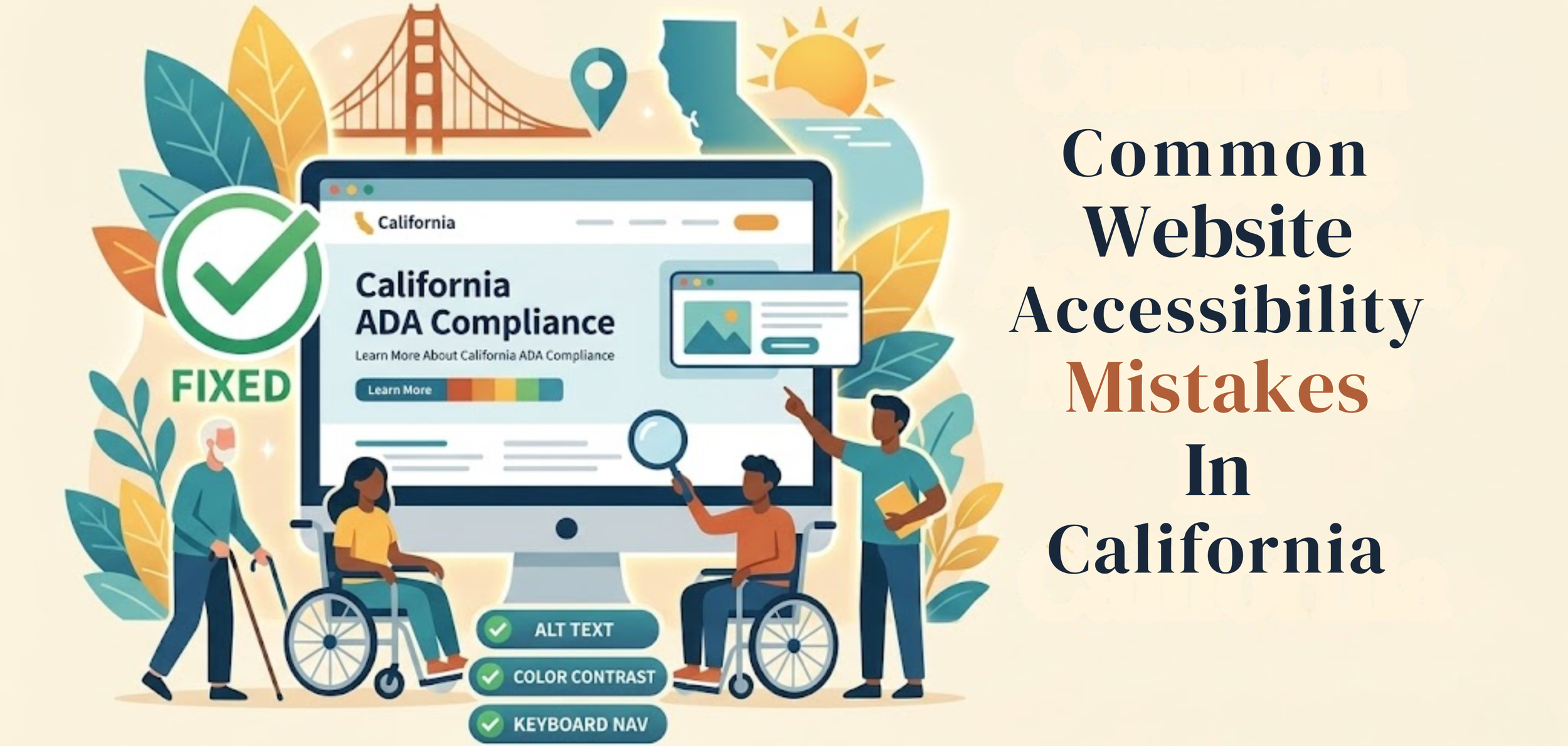
Most accessibility issues are not dramatic. They are basic mistakes that block normal use. Common examples include:
Missing alt text on images
Low color contrast
Menus that do not work with the keyboard
Forms without clear labels
Buttons with vague names
Videos without captions
PDFs that are not readable by screen readers
Error messages that are hard to find or understand
These are the kinds of issues that often sit unnoticed for months. A site may look clean on a laptop but still fail a user who relies on assistive technology. That is why California website accessibility laws for small businesses matter in everyday web design, not just legal discussions.
What Small Businesses Should Do Now
The smartest move is to treat accessibility as ongoing maintenance, not a one-time badge. Start with an web accessibility audit. Then fix the most important pages first. Home, navigation, contact, booking, cart, checkout, and service pages should come before less-used pages. Review uploaded PDFs and videos too. A website is only as accessible as the tools and files inside it.
It also helps to build a simple internal process. Train the person who uploads content. Check new plugins before adding them. Test forms after updates. Use manual review, not just automated scans, because many problems involve real user experience and cannot be caught by a tool alone.
What This Means Going Forward
The clearest way to understand California website accessibility laws for small business websites is this: if your website is part of how customers use your business, accessibility belongs on the same list as security, mobile performance, and clear content. It is a customer access issue first, and a legal risk issue right behind it. Waiting until someone complains usually costs more than checking the site early.
Make Your Next Website Update A Smarter One
Small businesses do not need fear-based advice. They need a clear process, a realistic review, and steady fixes over time. That is the practical path to ADA website compliance for small businesses in California. For teams that want a focused next step, Inclusive Web can help assess problem areas and guide a more accessible website.
Have Questions?
We Are Inclusive Web
We work with our clients to simplify digital accessibility to ensure your web and digital applications are ADA compliant and accessible to all your users. If you’d like to talk about your digital accessibility, you can email us at matthew@inclusiveweb.co, leave us a note here, or schedule a call here to discuss. Let’s make the web inclusive to all!