
Why New York Businesses Are the #1 Target for ADA Website Lawsuits
New York has quietly become the most active state in the country for ADA website lawsuits. Owners of dental practices, retail brands, restaurants, law firms, and small service businesses are receiving demand letters and federal complaints for accessibility issues most never realized existed on their site. Many assumed ADA enforcement only applied to wheelchair ramps and storefront entrances. In reality, websites are now the primary battleground, and New York is where most of the fight is happening. For business owners who want to understand their exposure before a plaintiff's firm does, the web accessibility services for New York businesses page outlines what a proper risk review actually covers.
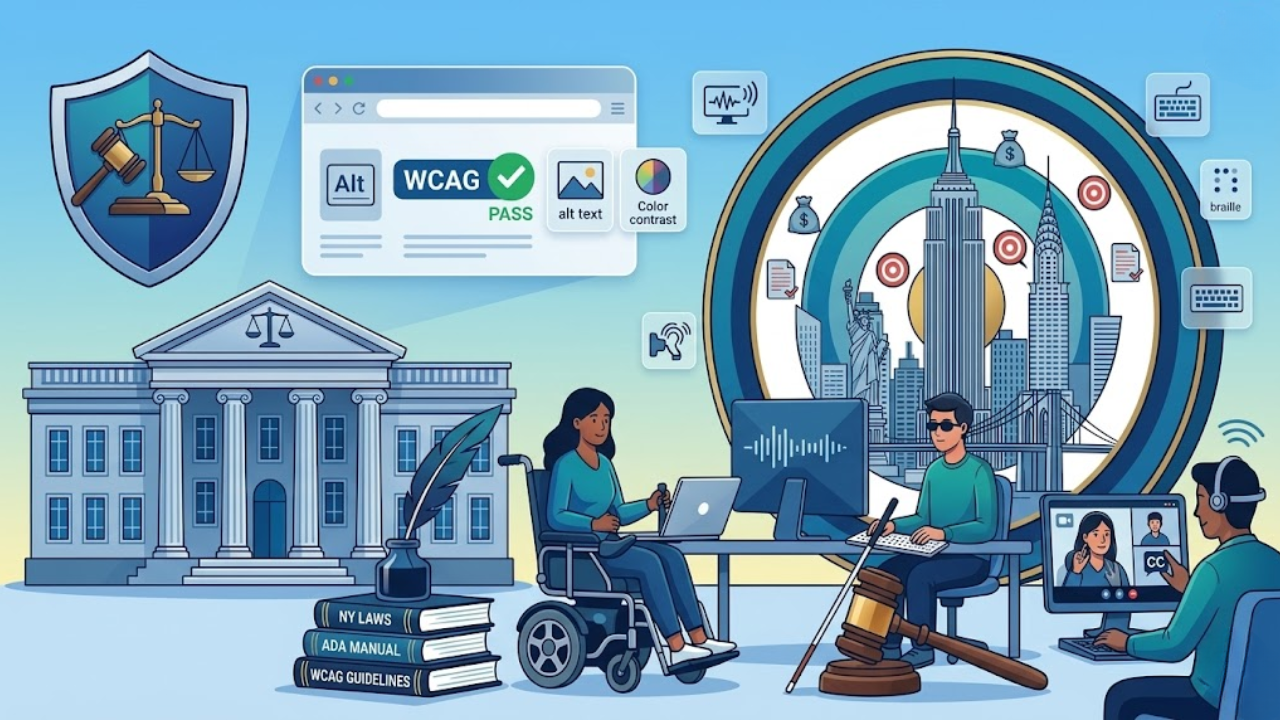
Why New York Sits at the Center of the Storm
Three factors put New York on top of the lawsuit map. The first is commercial density. The state has more businesses with public-facing websites than most others combined, which creates a large, easy pool of potential defendants. The second is the legal ecosystem. New York courts are familiar with ADA Title III cases, and a small group of law firms files most of the website accessibility complaints in the country. The third is the speed of digital adoption. Every restaurant menu, retail catalog, booking calendar, and service form is online now, which means every business has a digital surface that can be tested for accessibility.
Most owners only learn about this exposure after the fact. The first signal is usually a demand letter citing inaccessible elements: missing alt text on product images, contact forms that screen readers cannot navigate, color contrast that fails for low-vision users, or checkout flows that cannot be operated with a keyboard. These are not edge cases. They are the most common patterns seen across audits.
The Lawsuit Trend Is Accelerating Across New York
The number of ADA website lawsuits filed in New York has grown year over year, and the pace shows no sign of slowing. What used to be a concern for large retailers is now reaching small and mid-size businesses, including local clinics, boutique stores, restaurants, agencies, and service providers who never expected their website to become a legal target. Plaintiffs are using automated scanning tools to identify non-compliant sites at scale, then filing complaints in volume. For business owners who want a practical playbook before this reaches them, thisguide on how to protect your business from ADA website lawsuits in 2026 is the right starting point.
New York Stacks Multiple Accessibility Laws
Most states give businesses one accessibility statute to consider. New York layers several. The federal ADA Title III applies first. The New York State Human Rights Law and the New York City Human Rights Law add additional layers, each with their own enforcement standards and remedies. A single inaccessible page can trigger overlapping claims under more than one of these laws at the same time.
This is why so many New York businesses underestimate their exposure. Owners often focus on the federal ADA alone, without realizing that state and city laws can apply on top of it, sometimes in ways the ADA does not. For a clear breakdown of every statute that affects public-facing websites in the state, this reference on the digital accessibility laws New York businesses must follow in 2026 walks through what applies and where.
Most New York Websites Fail Basic Accessibility Checks
This is the uncomfortable part of the conversation. Across most site reviews, the violations are not unusual or hard to find. They tend to be the same handful of issues repeating on page after page:
Missing alt text on product images and key visuals
Color contrast that falls below readable thresholds
Form fields with no labels, or labels read incorrectly by screen readers
Keyboard navigation that breaks at menus, modals, or checkout steps
Vague link text, empty links, and skipped heading structures
Each of these is testable. Each is fixable. And each, on its own, has been enough to support a website accessibility complaint in front of a New York judge.
What WCAG Compliance New York Courts Actually Recognize
The standard New York courts and accessibility advocates measure websites against is WCAG, the Web Content Accessibility Guidelines. WCAG is built on four principles: perceivable, operable, understandable, and robust. Each principle maps directly to the kinds of failures that show up in real complaints. WCAG compliance New York businesses can rely on is what separates a defensible site from a vulnerable one. For a full explanation of the framework and what it requires in practice, this Web Content Accessibility Guidelines breakdown walks through every level and what it means for a real business website.
Why Accessibility Widgets Are Not Enough
Many business owners install an accessibility widget or overlay, place a compliance badge in the footer, and assume the issue is handled. In practice, lawsuits continue to be filed against sites that use widgets. Courts have repeatedly declined to accept overlays as a substitute for an accessible underlying website. A widget can change text size or toggle contrast, but it cannot rewrite the structural problems in the code, the forms, the navigation, or the content hierarchy. What actually protects a business is remediation at the code level, paired with content and design work that meets WCAG standards.
How Inclusive Web Helps New York Businesses Reduce Their Risk
Inclusive Web works specifically with businesses facing this exact risk profile: a public-facing website that has never been formally tested, a rising volume of plaintiff activity in the state, and a layered legal environment that punishes guesswork. The focus is moving owners from uncertainty to a documented, defensible compliance position, with audits, hands-on remediation, and ongoing monitoring built around WCAG. The work in this space was recently recognized with the 2025 Best in Business award for AI in social good. If you want a clear picture of where your website stands before the next demand letter arrives, that is the conversation worth having now.
FAQ
1. Why are New York businesses targeted for ADA website lawsuits?
New York businesses are often targeted because the state has a high number of public-facing websites, active plaintiff law firms, and courts that regularly handle ADA website accessibility cases.
2. What types of New York businesses are at risk of ADA website lawsuits?
Dental practices, retail stores, restaurants, law firms, clinics, agencies, eCommerce brands, and local service businesses can all be at risk if their websites are not accessible.
3. Why are New York businesses targeted more than businesses in other states?
New York combines commercial density, a large concentration of plaintiff-side accessibility law firms, and overlapping federal, state, and city accessibility laws. That combination creates the highest exposure profile in the country for any business with a public-facing website.
4. Why are New York businesses targeted more than businesses in other states?
New York combines commercial density, a large concentration of plaintiff-side accessibility law firms, and overlapping federal, state, and city accessibility laws. That combination creates the highest exposure profile in the country for any business with a public-facing website.
5. Can my New York business get sued if my website is not accessible?
Yes. If your website has accessibility barriers like missing alt text, poor keyboard navigation, unreadable contrast, or inaccessible forms, your business may be exposed to ADA website lawsuit risk.
Have Questions?
We Are Inclusive Web
We work with our clients to simplify digital accessibility to ensure your web and digital applications are ADA compliant and accessible to all your users. If you’d like to talk about your digital accessibility, you can email us at matthew@inclusiveweb.co, leave us a note here, or schedule a call here to discuss. Let’s make the web inclusive to all!